
Key Takeaways
- • Workflows become candidates for agentic delegation only when their internal steps are clearly defined and their inputs and outputs are predictable.
- • Deconstructing complex processes into specialized, modular agent roles improves output quality by focusing each agent on a single, well-defined phase of the workflow.
- • Implementing scoped access ensures that agents only receive the specific data required for their task, effectively preventing scope creep and unintended system actions.
- • Replacing open-ended conversations with structured handoff contracts between agents enhances traceability and allows individual modules to be validated or swapped independently.
Who this is for
AI developers and operations leads designing multi-agent systems for workflow automation
When Workflows Stabilize
A workflow becomes a candidate for delegation once it meets two criteria:
- The steps are defined clearly enough that someone else could follow them
- The inputs and outputs of each step are predictable
The newsletter process (Part 2) reached this point after a single use. Each phase - from source gathering through humility audit to final formatting - had clear boundaries, clear inputs, and verifiable outputs.
That makes it agentizable.
Five Agent Roles
The newsletter workflow splits naturally into five specialized roles:
Historian (Phase 1-2)
Finds origin material, prior conversations, old prompts, and project lineage. Gathers the raw context that everything else builds on.
Access: project docs, selected prior chats, repo metadata
Structurer (Phase 3)
Turns raw material into architecture. Defines section order, content mapping, and information hierarchy. Produces the blueprint that the Writer follows.
Access: Historian output, site structure, prior newsletter templates
Writer (Phase 4)
Generates the draft within the established structure and scope. Follows tone rules and formatting constraints. Does not decide what to include - that was already decided.
Access: Structurer output, tone guidelines, source content
Auditor (Phase 5-6)
Runs the humility audit. Checks for overpromising, absolute language, misleading claims, tone mismatches. This role is not optional - it is a required gate before output.
Access: Writer draft, scope document, humility checklist
Publisher (Phase 7)
Formats the audited draft for the target platform. Produces copy-paste HTML, social post variants, subject lines. Handles the last mile between "done" and "deployed."
Access: Auditor-approved draft, platform specs, brand assets
Scoped Access, Not Full Access
A critical design decision: agents should not have full access to everything.
Each role receives only what it needs:
- The Historian can read project docs but cannot modify them
- The Writer receives the structure but not the raw source - preventing scope creep
- The Auditor sees the draft and the scope document - enough to verify alignment, not enough to rewrite
- The Publisher receives only the approved final version
This is not bureaucracy. It is how you prevent agents from doing things they were not asked to do.
Contracts, Not Conversations
Agent handoff sequence with scoped access
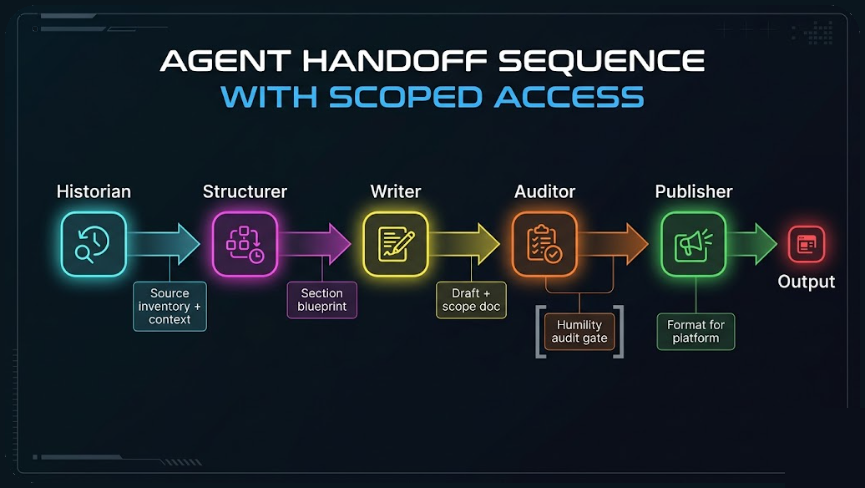
Each agent-to-agent handoff is defined as a contract:
| From | To | Handoff |
|---|---|---|
| Historian | Structurer | Source inventory + context summary |
| Structurer | Writer | Section blueprint + content mapping |
| Writer | Auditor | Draft + scope document |
| Auditor | Publisher | Approved draft + audit notes |
When agents communicate through structured contracts rather than open-ended conversations, several things improve:
- Failures are traceable - you can see exactly where the chain broke
- Roles are replaceable - swap one agent for another without redesigning the pipeline
- Quality is measurable - each handoff can be validated against its contract
Beyond Newsletters
The same pattern applies to any repeatable creative or technical workflow:
- Blog post production
- Documentation generation
- Report creation
- Social media content derivation
- Slide deck assembly
The agent roles may shift - a Code Reviewer replaces the Auditor, a Diagram Generator replaces the Publisher - but the structure remains.
Stable workflow. Clear roles. Scoped access. Verifiable handoffs.
That is how workflows become systems.
This article is Part 4 of the From Meta-Prompt to Asset Factory series on Adaptivearts.ai.
Previously: Building While Publishing: Turning Work Into Assets - every project should emit reusable materials. Next: SPINE as the Structural Layer - where 5PP lives inside SPINE.