
Key Takeaways
- • Adopting a 'capture and reuse' workflow transforms intermediate project scaffolding into a compounding library of text, visual, operational, and knowledge assets.
- • Capturing emergent outputs like prompt structures and validation checklists reduces friction in future projects by providing pre-built components for immediate reuse.
- • The asset-first building cycle creates long-term value by ensuring that the underlying development system improves with every project iteration.
- • Utilizing a specialized production stack, including workspace-aware agents and synthesis tools, enables the efficient extraction of high-quality derivative assets from raw materials.
Who this is for
Knowledge workers and builders seeking to turn their process into reusable operational assets
The Usual Pattern
Most projects follow a familiar cycle:
Build -> Finish -> Move on
Along the way, valuable intermediate work is produced: prompt structures, reasoning patterns, correction steps, formatting logic, evaluation criteria. These are treated as scaffolding - useful during construction, discarded afterward.
This is a waste.
A Different Cycle
The alternative is simple in concept:
Build -> Capture -> Refine -> Reuse -> Share
The difference is not in what you build. It is in what you keep.
When intermediate steps are captured rather than discarded, every project becomes a source of reusable components. Over time, these compound into a library of working patterns.
What Emerged from the Newsletter
During the creation of the first Adaptivearts.ai newsletter (Part 2), several intermediate outputs were produced that had value beyond the newsletter itself:
An alignment methodology - a 7-phase process for converting raw intent into verified output
A humility audit checklist - 8 specific checks for catching overpromising in AI-generated content
A revision tracking pattern - structured round-by-round documentation of what changed and why
An interactive alignment agent - a reusable tool that guides users through the same process
A process log - a complete record of how the work was done, not just what was produced
None of these were planned. They emerged as side effects of doing the work carefully.
Four Categories of Assets
The asset-first building cycle
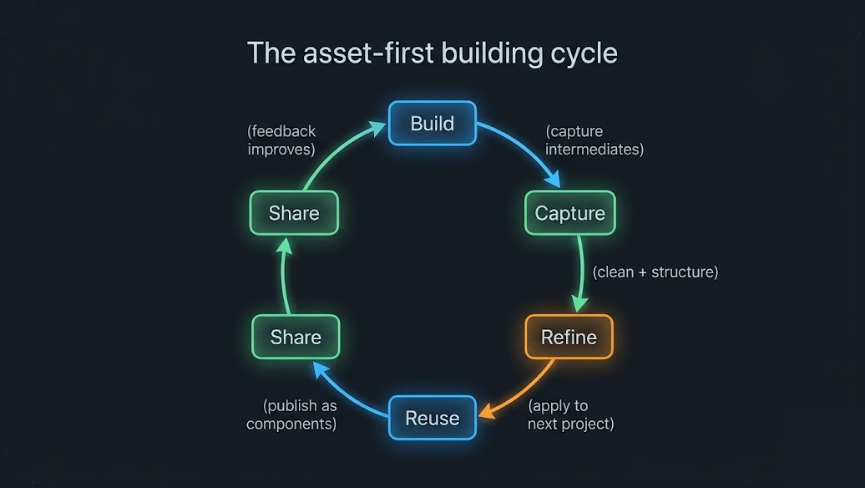
Looking across projects, assets tend to fall into four categories:
Text assets
Articles, newsletters, summaries, documentation, README fragments, FAQ entries, glossary terms. These can be derived from the same source material but shaped for different audiences and formats.
Visual assets
System diagrams, pipeline maps, presentation slides, hero images, infographic prompts, section illustrations. These make abstract concepts tangible and shareable.
Operational assets
Agent specifications, prompt structures, validation checklists, persona definitions, publishing workflows. These are the machinery that can be delegated and reused.
Knowledge assets
Process logs, reasoning patterns, failure notes, lessons learned, reusable schemas. These capture what was learned, not just what was built.
The Production Stack
Producing assets at scale requires tools. The current stack includes:
NotebookLM - for synthesis, source-grounded note condensation, and outline extraction from raw materials
LinkedIn - for outward distribution and thought-leadership derivatives from longer pieces
Nano Banana 2 - for diagram-like assets, infographics, post visuals, and section images. Particularly useful for precise text rendering, note-to-diagram workflows, and technically accurate illustrations
Workspace-aware agents - to move across the project base and generate derivative assets from source material
Each tool handles a different output type. The production logic connects them.
Why This Matters
There are practical benefits to building this way:
Reduced friction - you do not start from scratch every time. Patterns, checklists, and agent specs carry forward.
Better quality - each iteration improves the underlying system, not just the output.
Transparency - others can understand how something was built, not just what was built.
Compounding value - every project contributes to the next.
The system grows while it is being used.
This article is Part 3 of the From Meta-Prompt to Asset Factory series on Adaptivearts.ai.
Previously: The First Proof: Using 5PP to Align a Newsletter - how the protocol held under real working conditions. Next: From Workflow to Agents - turning stable processes into delegatable roles.