
Key Takeaways
- • The 5-Step Prompting Protocol (5PP) serves as a robust framework for maintaining technical accuracy and scope alignment during complex content creation tasks.
- • A dedicated 'Humility Audit' identifies and corrects subtle overstatements or inaccuracies that AI drafting processes often introduce into professional communications.
- • Implementing structured verification steps ensures that iterative revisions do not lead to scope drift or the dilution of original communication objectives.
- • Successful AI-assisted content alignment requires shifting language from promotional certainty to an exploratory tone that accurately reflects the current state of technical development.
Who this is for
Content strategists implementing structured AI workflows for precise technical communication
The Task
The request was simple: create the first newsletter for Adaptivearts.ai, based on existing site content.
No new research needed. No external sources. Just take what was already published - blog articles, the book project, SPINE demos, the open-science GitHub presence - and shape it into something sendable.
On paper, this should have been fast and unremarkable.
In practice, it became the first real test of whether 5PP could hold under actual working conditions.
Applying the Protocol
Each step of 5PP was applied explicitly:
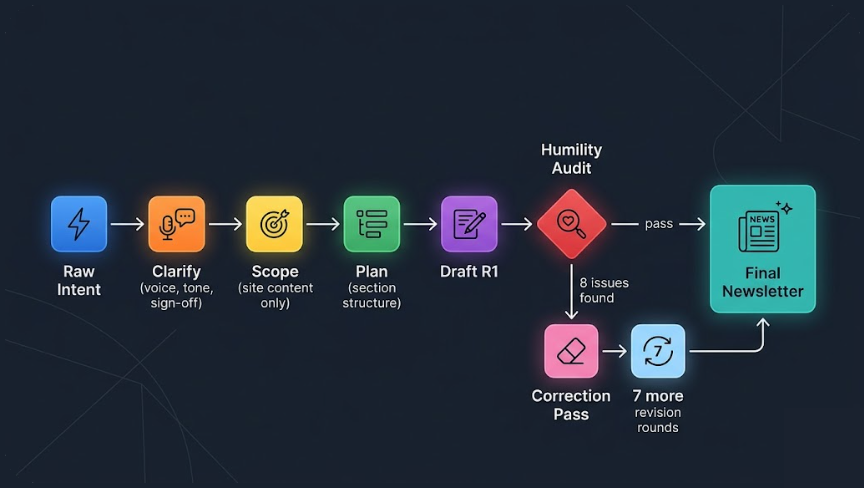
Step 1: Clarification
The task was restated: produce a copy-pasteable HTML newsletter for the Adaptivearts.ai compose form. Voice: "we" (not "I"). Tone: warm but technically credible. Sign-off: "We at Adaptivearts.ai."
Step 2: Scope Validation
In scope: existing site content only - homepage, blog, book, demos, GitHub. Out of scope: external news, promotional language, content not already published. Constraint: no em dashes (site style rule).
Step 3: Reasoning Plan
Structure the newsletter as: welcome, origin story, research directions, article highlights, book + demos, SPINE demos, open science, closing invitation. Keep it scannable.
Step 4: Execution
The first draft was generated within the established boundaries. Subject line, HTML content, semantic tags only (the newsletter system wraps styling automatically).
Step 5: Verification
The draft was audited against the original intent. This is where things got interesting.
The Humility Audit
Step 5 revealed something the other steps had missed: the draft was overpromising.
Not dramatically - but consistently. Small phrases that sounded confident where the reality was exploratory. Claims of completeness where the work was still in progress. Language that implied finished products where prototypes existed.
Eight specific issues were flagged:
- "quite a lot has been built" - slightly boastful
- "quality-controlled output through multi-agent voting" - reads like a solved problem
- "They are how trust gets built" - too declarative
- "No filler, no fluff" - promise about future issues
- Article teasers using marketing-style certainty
- "over 30 MCP servers" - factual but implied all were public
- "That belief still drives everything we do" - slightly grand
- Open science section implied everything was already shared publicly
Each was corrected. Not removed - softened. The shift was from "we built this and it works" to "here is what we are exploring and why."
Eight Rounds of Iteration
After the humility audit, seven more rounds of revision followed. Each was driven by a specific concern:
R1 - Initial draft from site content
R2 - Attribution line removed ("Fredrik Bratten" sign-off replaced with "We at Adaptivearts.ai")
R3 - GitHub display changed from "fbratten" to "adaptivearts.ai"
R4 - SPINE framework section added with 6 interactive demos
R5 - Origin story paragraph added (why Adaptivearts.ai exists)
R6 - Full humility audit - 8 overpromising phrases corrected
R7 - Open science section rewritten (acknowledged private repos honestly)
R8 - Demo links corrected, lab reference removed, everyday-AI invitation added to closing
The entire process - from first request to final copy-paste HTML - took roughly two hours.
The 5PP alignment process applied to newsletter creation
What the Process Proved
The newsletter was the output. But it was not the point.
What the process demonstrated was that 5PP could:
Prevent drift - the scope stayed locked throughout eight rounds of revision
Catch self-generated errors - the humility audit found problems the drafting step had introduced
Maintain alignment across iterations - each revision built on the previous one without losing the original intent
Produce a verifiable audit trail - every change had a documented reason
The protocol held. And the process itself became something more than a way to write newsletters.
It became a reusable system.
This article is Part 2 of the From Meta-Prompt to Asset Factory series on Adaptivearts.ai.
Previously: From Giant Meta-Prompt to 5PP - why the original prompt was too large to stay isolated. Next: Building While Publishing: Turning Work Into Assets - every project should emit reusable materials.