
Key Takeaways
- • SPINE provides a structural framework that allows AI agents to maintain persistent reasoning, memory, and execution protocols across different tasks and sessions.
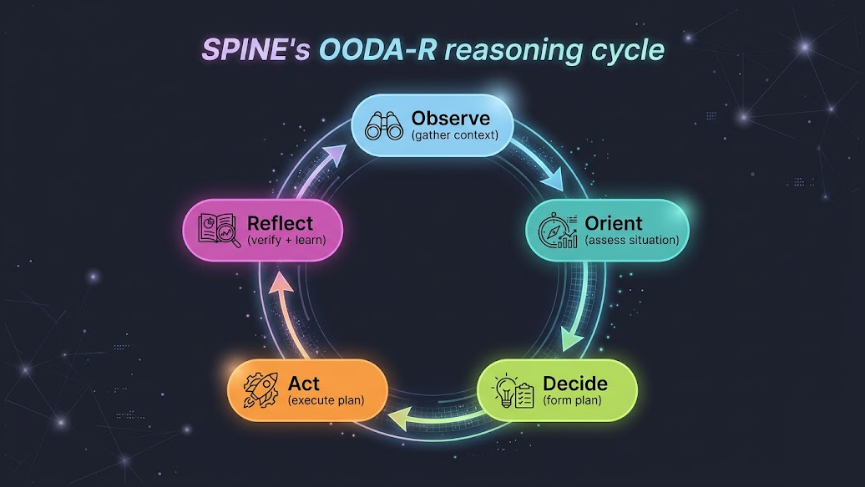
- • The framework utilizes a standardized OODA-R reasoning cycle to guide agents through observation, orientation, decision-making, action, and reflection for verified outcomes.
- • Consistent agent behavior is achieved through a six-layer context stack that organizes information from global operator profiles down to specific task inputs.
- • SPINE implements a sophisticated seven-tier memory architecture to manage the lifecycle of information from volatile session states to persistent deep knowledge and relational graphs.
- • The Five-Point Protocol (5PP) is integrated directly into SPINE’s data structures to transform abstract alignment principles into durable and traceable execution workflows.
Who this is for
AI developers building persistent and structured autonomous agent architectures
The Need for Persistence
5PP solves the alignment problem for a single task. The agent pipeline (Part 4) extends this to delegation. But neither solves a deeper problem: how to make structure persist across tasks, sessions, and systems.
Without persistence, every new task starts from zero. The agent pipeline works - but it has to be rebuilt each time. The humility audit catches errors - but it does not remember what it caught before.
This is where SPINE comes in.
What SPINE Provides
SPINE is a framework for structuring how AI agents reason, remember, and execute. It provides:
Context organization - structured layers that define what an agent knows and when
Memory layering - a tiered architecture from working memory to long-term knowledge
Execution tracing - every action is recorded with cost, timing, and outcome data
Structured reasoning flow - a defined cycle of observation, orientation, decision, action, and reflection
These are not abstract concepts. They are implemented as concrete data structures and tools.
SPINE's OODA-R reasoning cycle
5PP Inside SPINE
The Five-Point Protocol maps directly onto SPINE's architecture:
| 5PP Stage | SPINE Function | What Happens |
|---|---|---|
| Clarification | Context framing | The context stack is assembled - what the agent knows, what it needs, what constraints apply |
| Scope Validation | Boundary definition | Explicit boundaries are set on what the agent can and cannot do |
| Reasoning Plan | Structured thinking | The OODA loop (Observe-Orient-Decide-Act) processes the plan before execution begins |
| Execution | Action layer | Actions are wrapped in ToolEnvelopes - traced, timed, and recorded |
| Verification | Reflection and trace | The Reflect phase audits the output against the original context and scope |
5PP is not a separate system running alongside SPINE. It is a pattern that SPINE makes durable.
The Context Stack
SPINE organizes context into six structured layers:
Layer 6 - global: Operator profile, brand identity
Layer 5 - character: Speaker persona, target audience
Layer 4 - command: Task specification, success criteria
Layer 3 - constraints: Tone, format, do/don't rules
Layer 2 - context: Background information and references
Layer 1 - input: User request
Each layer is assembled reproducibly. The same stack produces the same reasoning conditions - which is how you get consistent behavior across agents and sessions.
Try it yourself: Context Stack Builder demo
Memory Architecture
SPINE's memory system has seven tiers, from volatile working state to persistent knowledge:
T1 KVStore - key-value working state (fast access, session-scoped)
T2 Scratchpad - session working notes (append-only, ordered)
T3 Vector store - semantic retrieval over stored content
T4 Ephemeral memory - decay-based session working store
T5 Episodic memory - past sessions and episodes (persists)
T6 Deep memory - persistent knowledge in PostgreSQL with pgvector
T7 Graph memory - relationship traversal across entities
Beyond the seven tiers, SPINE's memory design includes three functional layers: a write-path admission layer (Warrant scoring + VerdictRouter, deciding whether task results earn persistence), a read-path surfacing layer (the Reflective Memory Pattern, deciding when accumulated snapshots rise into cognitive events), and a maintenance cycle (DreamCycle, with six phases: decay, forgive, consolidate, neglect, review, prune). These are shipped as tested modules; activity depends on configuration and may be scheduled, event-triggered, or dormant depending on how SPINE is wired for a given workload.
The humility audit from 5PP Step 5 benefits directly from this: the Auditor agent can recall what was flagged in previous newsletters and check whether the same patterns are recurring.
Explore the architecture: Memory Explorer demo
What This Enables
With SPINE as the structural layer, systems can:
Remember - agents retain what they learned across sessions
Reproduce - the same context stack produces consistent results
Trace - every action has a recorded cost, duration, and outcome
Improve - memory feeds back into future reasoning
5PP provides the reasoning discipline. SPINE provides the infrastructure that makes it persist.
This article is Part 5 of the From Meta-Prompt to Asset Factory series on Adaptivearts.ai.
Previously: From Workflow to Agents - turning stable processes into delegatable roles. Next: Beyond Content: Research Loops, Autoresearch, and Embodied Agents - the same machinery applied to research and physical systems.