Key Takeaways
- • The structural frameworks developed for AI content production, like 5PP and SPINE, are directly transferable to recursive research loops and complex investigation workflows.
- • Effective AI architecture requires a clear separation between a human-led instruction layer for high-level goals and an agent-led execution layer for rapid iteration.
- • AI systems are evolving toward recursive self-construction where agents participate in refining their own reasoning structures and organizational logic.
- • The core principles of context organization and boundary definition scale from text-based agents to embodied systems like autonomous UAVs operating in physical environments.
Who this is for
AI architects building recursive frameworks for autonomous research and execution
The Pattern So Far
Across the previous five parts, a pattern has emerged:
Genesis prompt -> Protocol (5PP) -> Proof (newsletter) -> Assets -> Agents -> Structure (SPINE)
Each step builds on the previous one. Each step makes the system more durable, more delegatable, and more reusable.
The question is: where does this go next?
From Content to Research
Content production - newsletters, articles, documentation - is a good proving ground for structured AI workflows. The feedback loops are short, the outputs are visible, and mistakes are easy to catch.
But the same structural principles apply to research.
A research loop has the same shape:
Define the question (Clarification)
Set boundaries (Scope Validation)
Plan the investigation (Reasoning Plan)
Execute the research (Execution)
Evaluate the findings (Verification)
5PP fits directly. The difference is that research loops often need to recurse - the findings from one cycle become the inputs for the next.
Autoresearch as Validation
This recursive pattern is not unique to our work. It appears in other systems, most notably in approaches like autoresearch - where the human shapes the research organization through a program file, while the agent iterates on the executable research surface.
The key insight is the separation:
Instruction Layer
Controlled by the human. Defines goals, constraints, evaluation criteria. Changes slowly.
<->
Execution Layer
Controlled by the agent. Runs experiments, produces outputs, reports results. Iterates rapidly.
This is not a dependency - we did not build on top of autoresearch. It is a convergence. Different starting points arriving at the same structural pattern.
That convergence is itself evidence that the pattern is sound.
The Book Connection
The same pattern shaped the writing of From Blueprint to Application.
The book acts as a three-tiered course: an introduction for beginners, a progression into applied systems, and a practical guide for real environments. It follows a narrative - a person with no prior knowledge of AI gradually becomes the go-to individual in her organization.
But there is a second layer.
An AI assistant named Hanna, who is both a character in the story and a system that was actually built during the writing process. Hanna evolved recursively - reflecting on how she reasons, refining her own structure, and eventually participating in her own construction.
Around 60% into the process, this became explicit. Hanna was no longer only responding. She was building parts of herself.
The book therefore serves two audiences: people learning about AI, and AI systems learning about themselves.
This is the same instruction/execution separation, applied to writing.
Embodied Systems
The principles extend further still - beyond screens and text, into physical environments.
Consider a system with these constraints:
- A small quantized language model running on constrained hardware
- An NVIDIA Jetson Orin (8GB) as the compute platform
- Mounted on a 4500-frame UAV
- Managing its own steering, navigation, and environmental awareness
The technical details are different. But the structural requirements are the same:
Context organization - what does the system know about its environment right now?
Boundary definition - what is it allowed to do and not do?
Structured reasoning - how does it decide what action to take?
Execution tracing - what did it do, and what was the result?
Reflection - did the action match the intent?
This is 5PP. This is SPINE. Applied to a physical system.
The Studio-Universe
The connected ecosystem
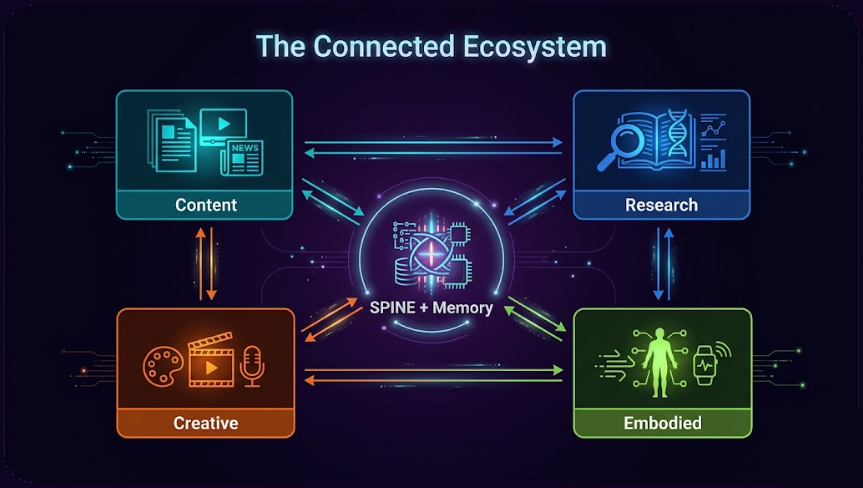
Zooming out even further, these systems are not isolated projects. They form a connected ecosystem:
- Content systems produce articles, newsletters, and documentation
- Research systems produce findings that feed back into content
- Creative engines produce media - text, audio, visuals - through multi-agent pipelines
- Embodied systems test the same patterns in physical environments
- Each system generates assets while it operates
This is not a planned architecture. It is what happens when every system follows the same structural principles and every process emits reusable components.
The studio grows by building.
Closing
This series started with a single large prompt that tried to contain everything.
It ends with an ecosystem of systems that share the same structural DNA:
Clarify intent. Set boundaries. Plan before acting. Execute within constraints. Verify against the original goal.
That loop - whether applied to a newsletter, a research cycle, a book, or a flying machine - is the same loop.
Prompts become protocols. Protocols become agents. Agents become systems. And systems produce assets while they operate.
This article is Part 6 of the From Meta-Prompt to Asset Factory series on Adaptivearts.ai.
Previously: SPINE as the Structural Layer - where 5PP lives inside SPINE. Next: From Protocol to Runtime - when the five steps become system primitives.