
Key Takeaways
- • Effective recursive systems must transition from flat repetition to a vertical abstraction pyramid that moves from raw data to meta-reasoning.
- • Selective promotion is critical to prevent noise, ensuring only items meeting specific criteria like high confidence or emergent patterns advance to higher processing layers.
- • Implementing level-specific protocols allows the system to interpret standard reasoning steps differently depending on whether it is analyzing individual items or deriving abstract principles.
- • Maintaining strict separation between abstraction levels acts as a vital guardrail against hallucination amplification and incoherent processing loops.
- • Scaling a recursive engine requires a tiered memory architecture that organizes stored knowledge according to its level of abstraction and granularity.
Who this is for
AI architects building advanced multi-layered recursive reasoning systems
Beyond One Pass
A single run of the five-point protocol produces a result. But the result is flat - it does not build on itself, does not learn, does not refine.
The real transition is from "reasoning engine" to recursive cognition system - where each output can become a new structured input at a higher level of abstraction.
But recursion is not simply "run again." Naive recursion - feeding output back as input repeatedly - causes drift, redundancy, exponential noise, and no convergence.
Controlled recursion requires structure.
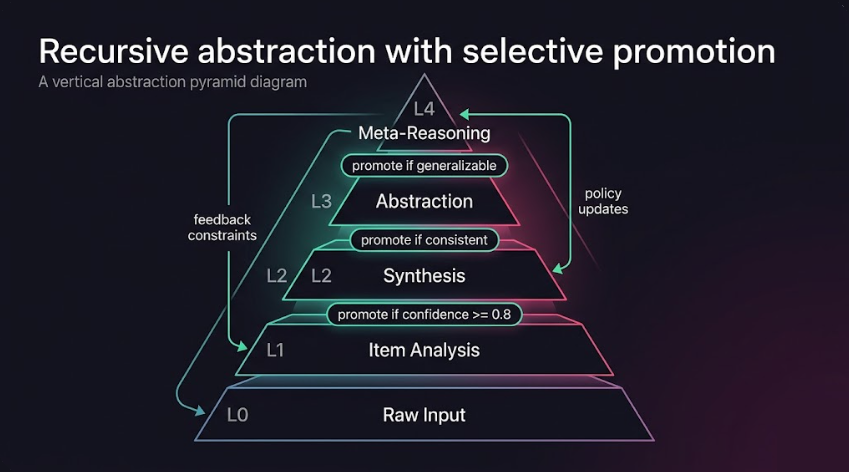
The Abstraction Pyramid
Instead of flat repetition, the engine builds vertically:
L4 - Meta-Reasoning: About reasoning itself
L3 - Abstraction: Emergent patterns and principles
L2 - Synthesis: Cross-item connections
L1 - Item Analysis: Individual items processed
L0 - Raw Input: Signals and data
Each layer consumes the one below, produces something more general, and feeds back constraints. Recursion is vertical movement through abstraction layers - not horizontal repetition.
Four Mechanisms for Controlled Recursion
1. Typed Outputs
Every output must declare what it is - its type, its abstraction level, its granularity. Without this, the engine cannot know what can be re-processed, at what level, or for what purpose.
2. Promotion Rules
You do not recurse everything. You promote selected outputs based on criteria:
- High confidence items promote to synthesis
- Items with unresolved questions promote to exploration
- Contradictions promote to verification loops
- Low-confidence items are held or rejected
Recursion becomes selective, not brute-force.
3. Level-Specific Protocols
The same five steps apply at every level - but with different interpretation:
| Level | Clarify | Scope | Plan | Execute | Verify |
|---|---|---|---|---|---|
| L1 Item | What is this? | What matters? | How to evaluate? | Analyze | Correctness |
| L2 Synthesis | What connects? | Shared vs conflicting | Grouping | Merge insights | Consistency |
| L3 Abstraction | What pattern? | General vs specific | Derive principle | Create model | Generalizability |
| L4 Meta | Reasoning failure? | Quality scope | Improve process | Refine | Better outcome? |
4. Tiered Memory
Each recursion level writes to a different memory tier:
Tier 1: Raw observations
Tier 2: Analyzed items
Tier 3: Synthesized insights
Tier 4: Abstract patterns
Tier 5: Policies and heuristics
Memory is not flat storage. It mirrors the abstraction hierarchy.
Recursive abstraction with selective promotion
Scaling the Recursion
The system scales through four mechanisms working together:
Parallelism - each item gets independent execution at L1
Hierarchical aggregation - groups become clusters become systems
Selective promotion - only meaningful outputs move upward
Feedback loops - meta-layer insights influence lower layers
When you add cross-run memory (previous runs influencing new ones), pattern detection (repeated abstractions becoming reusable rules), and policy evolution (the system changing how it reasons over time), the recursive engine becomes genuinely self-improving.
The Critical Guard Rail
There is one thing that breaks recursive systems immediately:
Skipping level separation.
Without explicit boundaries between abstraction levels, recursion degrades into loops, hallucination amplification, and incoherent outputs. Each level must have its own scope rules, its own protocol interpretation, and clear contracts for what it accepts and emits.
The engine does not repeat. It climbs.
The Distilled Principle
To scale recursively, transform the protocol into a multi-level reasoning system with selective promotion, typed outputs, and hierarchical memory - where each recursion step operates at a higher level of abstraction rather than repeating the same process.
This article is Part 8 of the From Meta-Prompt to Asset Factory series on Adaptivearts.ai.
Previously: From Protocol to Runtime - when the five steps become system primitives. Next: Stability Under Volatility - how a recursive system remains coherent under uncertainty.