Prototype 03
Conceptual 38% mappedInterpretive Loop Diagrams
Visual frameworks for making the interpretive layers of AI systems explicit. Maps conversation quality metrics, satisfaction indicators, and the iterative refinement cycle between human intent and model behavior.
OODA Cycles & Iterative Reasoning
Observe, Orient, Decide, Act - at multiple levels of abstraction
SPINE
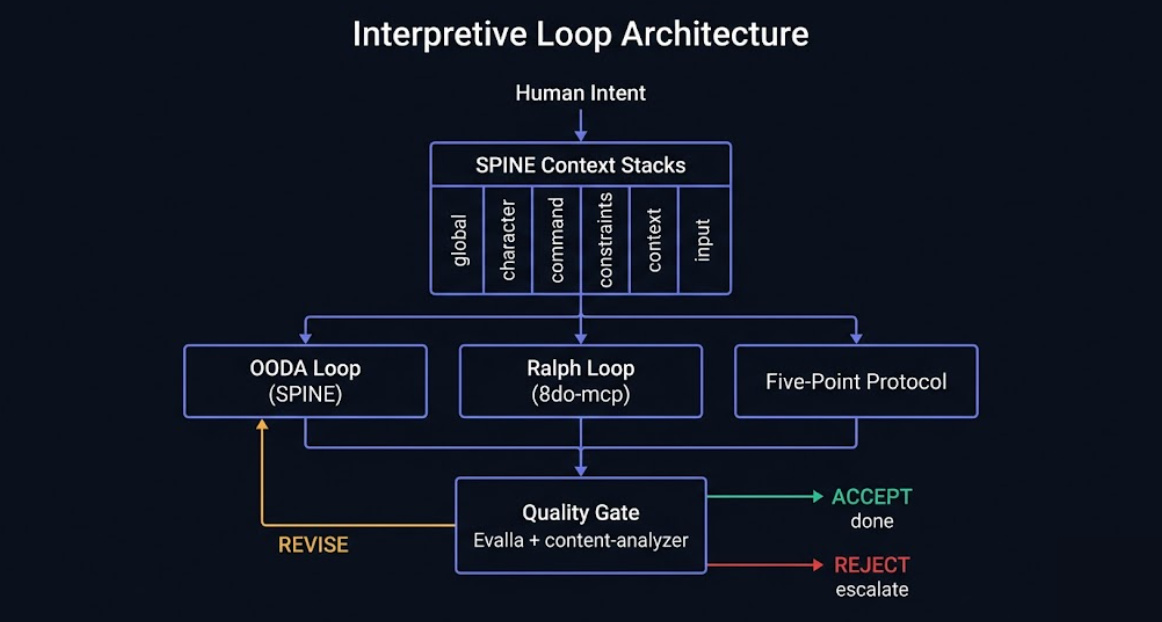
ooda_loop.pyOODA executor: Observe, Orient, Decide, Act with API tool usage. Context stacks (6 layers), MemoryHooks integration.
8do-mcp
Ralph LoopVerdict-gated task orchestration. Evidence-based verification (lint, typecheck, test, build) with ACCEPT/REVISE/REJECT gates. Circuit breaker safety.
8me-mcp
Loop-until-doneRalph Wiggum autonomous loop - predecessor to 8do-mcp. Tier-based deliverables (0-5.5) showing iterative progression.
Five-Point Protocol
FrameworkReproducible execution protocol: Clarify, Scope, Plan, Execute, Verify. Transforms intent into structured execution - the core "how we work" pattern for agentic workflows.
Quality Metrics & Satisfaction Indicators
Measuring output quality at every stage
evaluation-mcp (Evalla)
6 tools. Rubric-based scoring (0-100), batch scoring, ranking (MinMax/ZScore/Percentile), verdicts with reasoning. Confidence decay modeling.
content-analyzer-mcp
9 tools. Content quality scoring, aesthetic classification, semantic outlier detection (Isolation Forest), Gemini multimodal vibe checks.
showcase-mcp
check_public_readiness - 5-category validation including humility audit.
Context Engineering & Layered Interpretation
How context flows through structured layers to shape model behavior
SPINE Context Stacks
6-layer structured context: global, character, command, constraints, context, input. Enrichment sections for progressive refinement.
context-glue-mcp
Budget-managed context assembly, scenario composition with metadata, multi-scenario merging with dedup, platform-specific vocabulary (Claude/GPT/Gemini/Grok).
observation-workbench
Recursive reasoning: Observation, Route Resolver, Proposed Avenues, Execute Templates, Record Output + Verdict. 248-template library.
Visual Frameworks & Diagramming
Making system behavior visible and navigable
Tachylite
~5,700 line visual workflow canvas. Node-based editor, browser experience store, wiki-style linking, presentation mode.
tachylite-mcp
27 tools. Headless workflow CRUD: create, add_node, connect, auto_layout (grid/hierarchical/force), import Mermaid, describe in natural language.
browser-mcp
Click memory system - records interaction patterns, exports to Tachylite workflows.
intelligence-engine
Visual knowledge graph exploration via web UI. AST to semantic representation to visual code relationship browser.
Dashboard Infrastructure
Four production systems providing visual layers - not yet federated into a single view
intelligence-engine
Web UI :8420Sigma.js interactive knowledge graph, 6-tab dashboard (timeline, phases, health, compare, quality, AI memory), 33 REST endpoints. 53,000+ entities across 272 projects.
portfolio-ops-hub
Web UI :8000vis.js project relationship graph (183 projects, 207 relationships), 6-tab ops dashboard (overview, projects, knowledge, graph, intelligence, memory). Real-time scan/rebuild.
spine-dashboard
FastAPI + ReactOrchestration monitoring: run history, agent activity, task queue, token/cost metrics, trace viewer, log stream. Federated UI communicating with SPINE via HTTP API.
Tachylite
Canvas Editor~5,700 line visual workflow canvas. Node-edge editor with auto-layout (grid/hierarchical/force), Mermaid import, 27 MCP tools. Zero dependencies.
Prompt-as-Object Reasoning
Treating prompts as objects to be reasoned about, not just instructions to execute
Project-Prompt-as-a-Tool
Dynamic prompt-to-tool conversion via MCP. Sequential chaining, Jinja2 templates, runtime config. Prompts become composable, chainable objects.
content-mcp
PromptContract pattern - prompts as traceable, evaluable specification objects with lifecycle tracking.
Interpretive Loop Architecture
Capability Coverage
| Claim | Implementation | Status |
|---|---|---|
| Visual frameworks | tachylite-mcp (27 tools), browser-mcp click memory | Production |
| Interpretive layers explicit | SPINE context stacks (6 layers), context-glue-mcp | Production |
| Conversation quality metrics | Evalla rubrics, content-analyzer-mcp scoring | Production |
| Satisfaction indicators | Evalla verdicts (accept/revise/reject) | Production |
| Iterative refinement cycle | SPINE OODA, 8do-mcp Ralph Loop, Five-Point Protocol (framework) | Production |
| Human intent to model behavior | context-glue-mcp scenarios, SPINE context stacks | Partial |
| Prompts as objects | Prompt-as-a-Tool, content-mcp PromptContracts | Production |
| Unified visual dashboard | IE graph (Sigma.js) + portfolio-ops-hub (vis.js) + spine-dashboard (React) + Tachylite canvas - not yet federated | Partial |
Remaining Gaps - Path to 100%
Federated dashboard entry point
Single UI composing IE graph, spine-dashboard widgets, portfolio-ops-hub overview, and Tachylite canvas
Candidates: React shell with iframe/module federation
Live conversation metrics
Instrument SPINE OODA to emit quality/satisfaction signals per cycle
Candidates: Evalla hooks in OODA + spine-dashboard polling
Refinement visualization
Before/after of each OODA iteration as a diff diagram
Candidates: tachylite-mcp workflow generation
Context layer inspector
Visual breakdown of each of SPINE's 6 context layers
Candidates: context-glue-mcp + tachylite-mcp
The building blocks exist and are individually production-ready: 4 dashboard UIs, OODA executors, evaluation rubrics, context stacks, and workflow canvases. The remaining gap is federation - composing these into a single entry point. 14+ projects compose this prototype.
Project Deep Dives
Explore individual components in detail
Related Articles
Explore Live
Interactive showcases for the interpretive and orchestration systems.
SPINE OODA & DIALECTIC
Observe-Orient-Decide-Act loops with convergence tracking. 11+ interactive demos.
8me Learning Platform
15 progressive labs from basic loops to orchestrated pipelines. Tier 0-3 curriculum.
agentspool
Inter-agent messaging. SQLite-backed queues, atomic claims, HMAC relay, 14 MCP tools.
Adaptive MCP Orchestrator
Cognitive task dispatcher with preference weighting. 960+ tests, 16 modules.
Five-Point Protocol
Interactive meta-prompt template. Clarify, Scope, Plan, Execute, Verify.