
Key Takeaways
- • Production-grade reasoning requires a multidimensional approach that balances architectural modularity, data confidentiality, and systemic stability.
- • Formal schemas and contracts are essential for preventing architectural drift and ensuring consistency across all reasoning artifacts and system components.
- • Reliable recursive reasoning depends on strict operational controls, including bounded recursion depth, confidence gating, and explicit failure handling models.
- • Comprehensive provenance and lineage tracking are critical for auditing decisions and managing the complex state of distributed reasoning engines.
Who this is for
AI architects and engineers building production-ready reasoning systems
What Production-Grade Means
A system becomes production-grade when it can be run repeatedly, under load, with failures, with changing inputs, with multiple nodes, and with real consequences - without becoming opaque, fragile, leaky, or untrustworthy.
The conceptual skeleton exists: the cognitive model, the recursive model, the distribution model, the volatility model. What remains is what turns an elegant architecture into an operational system.
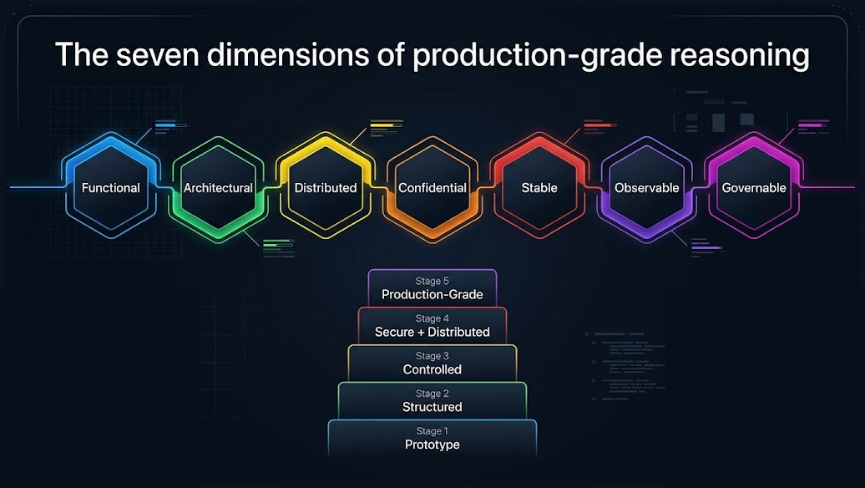
Seven Dimensions
A production-grade reasoning engine is strong across seven dimensions simultaneously:
1. Functional
It can actually do the job - ingest many input types, normalize them, run the protocol, recurse into synthesis and meta-reasoning, emit usable outputs.
2. Architectural
It is modular and separable - adapters, canonical state, reasoning runtime, verification layer, memory layer, policy layer, orchestration layer. Each can evolve independently.
3. Distributed
It can split work across environments - edge nodes for sensitive raw data, workers for analysis, a trusted core for policy and meta-reasoning. State is resumable.
4. Confidential
It enforces data minimization - raw data stays near origin, higher layers receive abstractions not secrets. Trust zones, redaction, access control.
5. Stable
It does not explode under volatility - confidence gating, circuit breakers, retries, fallbacks, consistency checks, temporal validation, bounded recursion.
6. Observable
You can inspect what happened - artifacts per phase, event logs, lineage of decisions, run IDs, metrics, replayability.
7. Governable
Humans can trust and control it - policies, approval points, escalation paths, versioning, audit trails, rollback.
The seven dimensions of production-grade reasoning
What Is Still Missing
Between the conceptual architecture and a production system, specific gaps remain:
Formal Contracts
RunContract, NormalizedState, ReasoningArtifact, PromotionDecision, VerificationReport, PolicyDecision - these need actual schemas, not just concepts. Without them, every component drifts.
Recursion Control
Maximum depth, promotion thresholds, demotion rules, retry budgets, halt conditions, conflict resolution. Without hard limits, recursion becomes a very smart blender.
Policy Engine
A separate layer that decides: may this be promoted? Must this be reviewed? May this be stored in memory? Should this run stop? Every action should pass a policy check. Deny-by-default for unknown cases.
Verification Harness
Not just "Step 5: verify" - a real scoring system that checks scope adherence, evidence coverage, contradiction rate, confidence quality, output completeness. Deterministic tests, benchmark tasks, replay-based regression.
Memory Admission
Rules for what gets remembered, forgotten, summarized, promoted from episodic to semantic. How conflicting memories are resolved. Without discipline, memory becomes contamination.
Failure Model
What happens when a node disappears, agents disagree, an artifact is malformed, confidence collapses mid-run, or the system detects a volatility spike? Production systems are defined as much by failure handling as by success paths.
Provenance and Lineage
Every artifact should know where it came from, what inputs produced it, which model and tool version touched it, what policy allowed it, and which parent artifacts it depends on. Without lineage, recursive systems are impossible to audit.
The Maturity Ladder
Stage 5 - Production-Grade: Governance, telemetry, failure handling, memory discipline
Stage 4 - Secure + Distributed: Trust zones, policies, artifact contracts, boundary enforcement
Stage 3 - Controlled: Recursion, verification, confidence gating, bounded depth
Stage 2 - Structured: Canonical schema and step artifacts exist
Stage 1 - Prototype: Basic pipeline works on controlled examples
The Most Important Missing Thing
If there is one thing to build first, it is:
Formal contracts for artifacts, promotion, trust level, and verification.
Because once those exist, most of the rest can be engineered around them. Contracts are the skeleton. Everything else is muscle and nerve.
The One-Sentence Definition
A production-grade reasoning system is one where every output can be trusted, traced, governed, and - if needed - safely ignored or rolled back.
That is the destination. The journey from protocol to runtime to recursive engine to stable system to production-grade infrastructure is the path described across this series.
It started with five steps written for a prompt.
It ends - or rather, continues - as architecture.
This article is Part 10 of the From Meta-Prompt to Asset Factory series on Adaptivearts.ai.
Previously: Stability Under Volatility - how a recursive system remains coherent under uncertainty. Next: The Cognitive Compiler - when 5PP starts compiling execution pipelines from a skill registry.