
Key Takeaways
- • DIALECTIC control replaces the traditional selection of a single winning hypothesis with a system that uses structured opposition to refine multiple coexisting paths.
- • The hermeneutic loop improves system outputs by identifying contradictions between branches and using that tension to generate superior, reformulated versions of each hypothesis.
- • Effective system control requires a dual-layer architecture where global orchestration manages branch creation while local processes execute and verify specific hypotheses.
- • Traditional reconciliation is replaced by a combination of relevance gating, temporal decay, and iterative refinement to ensure only contextually significant insights persist.
- • To prevent computational overhead or conceptual drift, dialectic systems must implement operational guards such as iteration limits, task anchoring, and branch pruning.
Who this is for
Systems architects and AI engineers building complex logic and reasoning frameworks
The Assumption of Collapse
Part 12 introduced branching - the system splitting into parallel hypotheses when facing ambiguity. The conventional next step is reconciliation: evaluate the branches, pick the winner, discard the rest.
But reconciliation assumes there is one correct path.
What if multiple valid paths can coexist depending on context? What if the tension between them is not a problem to solve but a resource to use?
From Decision to Possibility
The shift is fundamental:
| Traditional | DIALECTIC |
|---|---|
| Branch -> Evaluate -> Select | Branch -> Interact -> Refine |
| "Which one is correct?" | "What emerges when opposites interact?" |
| Collapse into one | Transform both |
| Decision system | Possibility system |
The system moves from selecting outcomes to generating better alternatives through structured opposition.
The Hermeneutic Loop
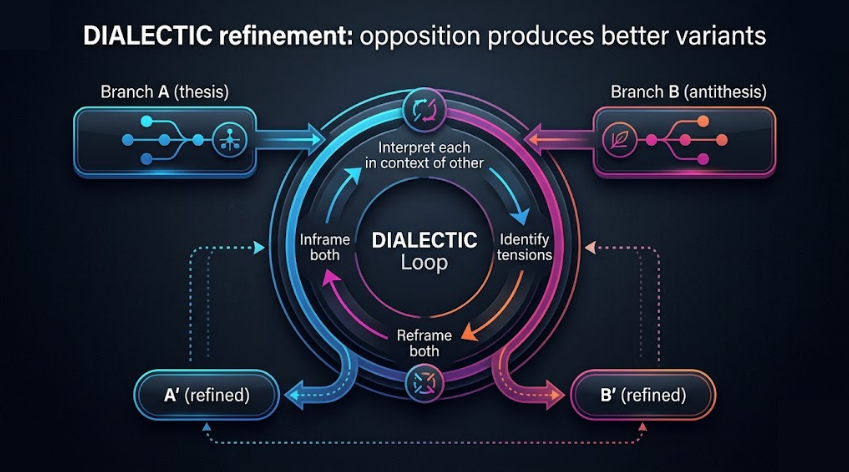
At the core of DIALECTIC is a hermeneutic internal loop - a cycle of interpretation, comparison, and reinterpretation:
1. Interpret - Understand each branch in its own terms
2. Compare - Read each branch in the context of its opposite
3. Tension - Identify the contradictions - where do they disagree and why?
4. Re-interpret - Each branch absorbs the tension and reformulates
5. Refine - Both branches emerge improved - neither destroyed
The result is not a winner. The result is two (or more) better versions.
A Concrete Example
Branch A (thesis)
"Use centralized memory"
Branch B (antithesis)
"Use federated memory"
The DIALECTIC loop runs:
Interpret A: optimized for consistency, simple queries, single source of truth
Interpret B in context of A: federated solves locality but introduces coordination cost
Identify tension: latency vs. consistency, locality vs. coherence
Reframe both:
A' = "centralized with local caching layers"
B' = "federated with a coordination protocol"
Neither branch was destroyed. Both were improved by exposure to their opposite.
DIALECTIC refinement: opposition produces better variants
Dual-Layer 5PP
With DIALECTIC, 5PP operates at two levels simultaneously:
Global 5PP (Orchestrator)
- Clarify - what is the overall task?
- Scope - what branches are allowed?
- Plan - where to branch?
- Execute - spawn branches
- Verify - monitor branch health
Local 5PP (Per Branch)
- Clarify - what is this branch exploring?
- Scope - what is this branch's boundary?
- Plan - how to execute this hypothesis?
- Execute - run the branch DAG
- Verify - evaluate this branch's result
The DIALECTIC layer sits between them - after local execution, before global verification - running the hermeneutic loop across branches.
What Replaces Reconciliation
Not a single mechanism, but a combination:
DIALECTIC - resolves contradictions, increases insight, generates refined variants
Relevance gating - determines which branches stay active based on context
Temporal decay - unused branches fade and archive over time
Optional reconciliation - only when forced (e.g., a final output must be singular)
Control is no longer "which one wins?" It is "which ones are relevant, and how have they refined each other?"
Guards Against Collapse
Unbounded dialectic interaction has its own risks:
Infinite loops - A refines B refines A' refines B'... Fixed by iteration limits and convergence checks.
Drift into abstraction - branches become too vague. Fixed by anchoring to the original task (5PP Steps 1-2).
Explosion of variants - too many refined branches. Fixed by pruning similar branches and merging near-identical ones.
The constraint is not "do not branch." It is "branch with discipline."
The Full Architecture
Everything now aligns into a single system:
5PP - Defines structure and flow
Skill Graph Compiler - Defines execution (DAG from skills)
Branching - Enables exploration (multi-hypothesis)
DIALECTIC - Enables refinement (opposition as resource)
Memory - Enables learning (across runs)
The Core Insight
Contradiction is not a problem to eliminate. It is a resource to exploit.
A system that can maintain competing models without collapsing prematurely, improve reasoning through opposition rather than confidence scoring alone, and generate novel solutions from synthesis rather than selection - that system has moved beyond execution into something closer to thought.
This is where the series arrives. Not at a finished system, but at a design space that is now visible:
From a five-step prompt protocol, through structured reasoning, recursive abstraction, stability engineering, production contracts, skill compilation, runtime identity, and dialectic refinement - a path from protocol to cognitive architecture.
The path continues. But the shape is clear.
This article is Part 13 of the From Meta-Prompt to Asset Factory series on Adaptivearts.ai.
Previously: Run Context and Identity - what "it" is when a system builds its own pipeline. Series start: From Giant Meta-Prompt to 5PP - where it all began.