
Key Takeaways
- • System identity in autonomous pipelines is defined by the Run Context, a formal data structure that integrates real-time execution state, structural architecture, and contextual purpose.
- • To achieve advanced self-correction, systems must move beyond simple execution to reflective awareness, where they can reason about and modify their own structural graphs during runtime.
- • A system’s identity is stabilized by four external anchors—initial task, constraints, environment, and feedback—which prevent execution degradation and self-referential collapse.
- • Effective design requires separating identity into three distinct layers: the active runtime node, the compiled structural pipeline, and the foundational contextual purpose.
Who this is for
AI system designers building autonomous agents and reflective execution pipelines
The Identity Problem
Part 11 ended with a question: when a system builds its own execution pipeline, what is "it"?
This is not a philosophical exercise. It is a design problem. If the system cannot identify itself - where it is in the graph, why it is running, what came before - then reflection, branching, and self-correction all become impossible.
"It" is not the pipeline. The pipeline is a structure that was compiled. "It" is the active run instance operating over that structure, within a context, under constraints.
Three Selves
A self-assembling system has three distinct aspects of identity:
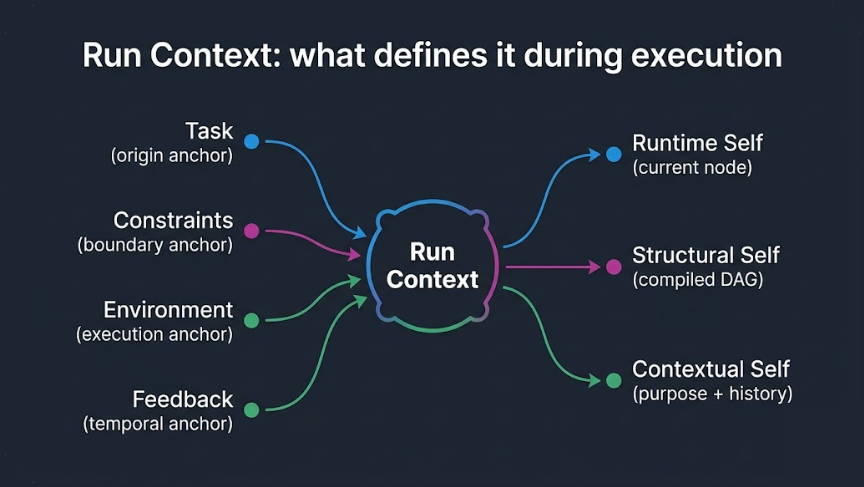
Runtime Self
What is executing right now. The current node, the active tool call, the in-flight computation.
Structural Self
The pipeline or DAG that was built. The architecture the system compiled for itself.
Contextual Self
Why this exists. The original task, the constraints, the purpose. The identity seed.
If these are not separated, everything becomes fuzzy. The runtime self changes constantly. The structural self was determined at compilation. The contextual self is the anchor that gives meaning to the other two.
The Run Context
The missing formalization in most systems is the Run Context - the data structure that answers "what is it?" at any point during execution:
run_id - Unique identifier for this execution
task - The original request - the identity seed
graph - The compiled DAG being executed
current_node - Where execution is right now
history - What has already happened
state - Accumulated artifacts and evidence
constraints - What the system is allowed to do
environment - Available tools, skills, compute
Identity is defined by past (history) + present (current node) + future (graph) + constraints (rules) + purpose (task). Not just "what is next."
Run Context: what defines 'it' during execution
Three Levels of Self-Awareness
Level 1: No Self-Reference
Node executes, passes output, next node runs. The system does not know what it is, where it is, or why it exists. Only: "what is next?" Purely forward-moving. Most systems operate here.
Level 2: Positional Awareness
"I am node 3 in a graph. I depend on node 2. My output feeds node 4." The system knows where it is in the pipeline, what came before, what comes next. This is where stability emerges.
Level 3: Reflective Awareness
The system can reason about the graph itself - whether the plan is valid, whether it should continue, whether the pipeline is wrong. "I am executing vulnerability-check, but dependency-analysis looks incomplete, so I should trigger a re-run." This is inflection. This is where the system can modify its own structure while inside it.
Four Sources of External Reference
A system's identity is not purely internal. It is anchored by four external sources:
Initial Task (Origin anchor): Defines purpose and success criteria. The identity seed.
Constraints (Boundary anchor): Defines what the system is allowed to be and do.
Environment (Execution anchor): Defines available tools, skills, data, and compute.
Feedback (Temporal anchor): Verification results, errors, confidence scores. Defines how it evolves.
Identity requires all three movements simultaneously: forward progression gives direction, external reference gives meaning, internal reflection gives control. Remove any one and the system degrades - blind execution, static rigidity, or self-referential collapse.
Branching
When the contextual self encounters ambiguity or conflicting strategies, it can trigger controlled divergence - branching the runtime into parallel hypotheses:
Run Context (identity) -> Branch Decision -> Branch A (plan variant 1), Branch B (plan variant 2), Branch C (plan variant 3)
Branches are hypothesis-bound executions. They share a parent identity but explore different paths. The identity is tree-structured, not duplicated.
But this raises a harder question: must the branches collapse into one? Must there be a reconciler?
Or can opposing paths coexist - and even improve each other?
This article is Part 12 of the From Meta-Prompt to Asset Factory series on Adaptivearts.ai.
Previously: The Cognitive Compiler - when 5PP starts compiling execution pipelines from a skill registry. Next: DIALECTIC as Control - when contradiction becomes a resource.