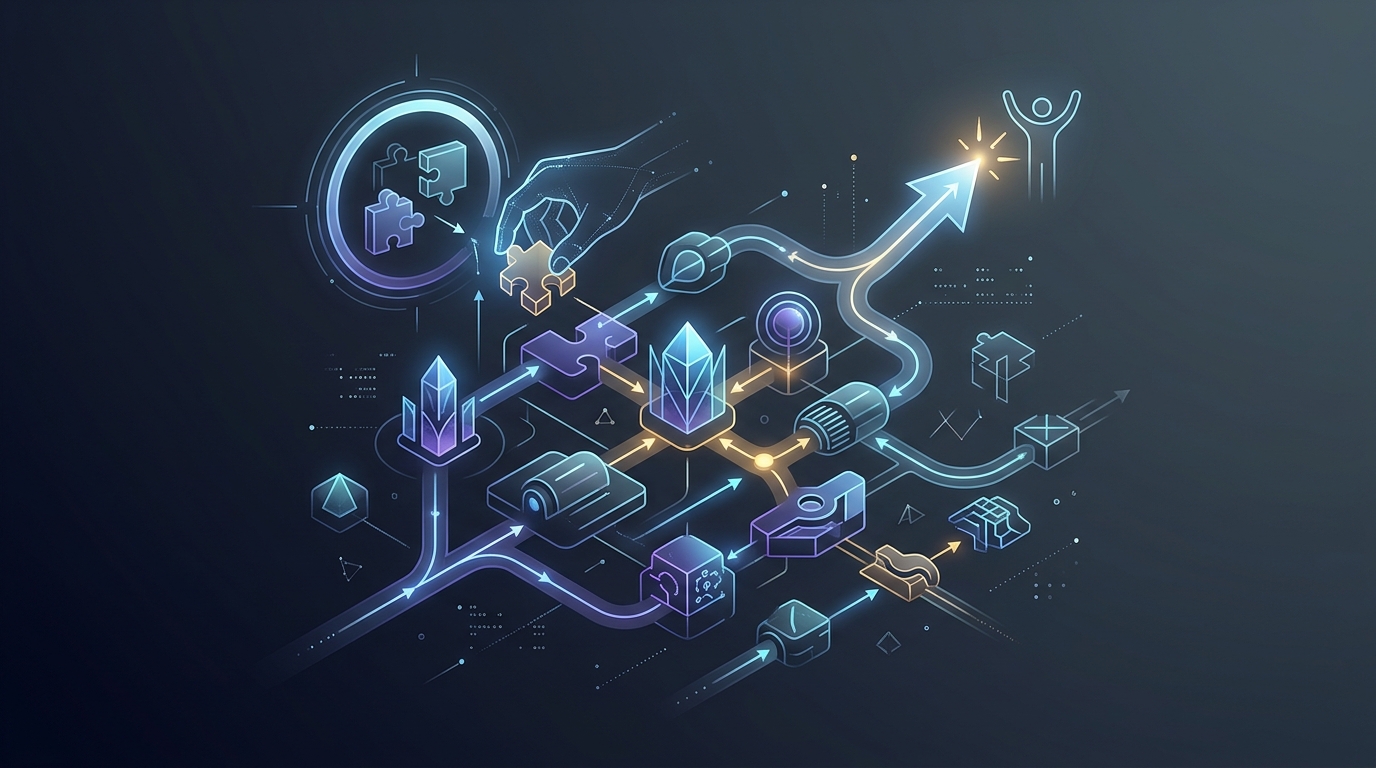
Key Takeaways
- • Professionals can regain significant time by automating repetitive, predictable tasks through a personal ecosystem of specialized, no-code AI knowledge agents.
- • Effective AI automation requires creating niche 'specialist agents' rather than a single general-purpose bot to ensure precision in specific domain tasks.
- • A central orchestrator is essential for coordinating complex workflows by assigning sub-tasks to the appropriate specialized agents within the ecosystem.
- • The 'Truth Loop' framework maintains quality by having humans audit AI-generated drafts for logic, accuracy, and strategic nuance before final delivery.
- • The professional landscape is shifting from simply using AI tools to building structured, automated systems where humans provide the final layer of emotional intelligence and oversight.
Who this is for
Non-technical professionals seeking to automate repetitive tasks with no-code AI agents
Stop Drowning in Daily Tasks: Build Your Own Personal AI Ecosystem (Even If You Know Zero Code)
By Adaptive Arts Guest Contributor
Ever feel like your entire workday is consumed by a relentless tide of repetitive, low-value tasks? Whether you are a fresh university student navigating your first internship, a newly hired employee trying to make a mark, or a seasoned senior leader who has never written a line of code, we are all drowning in the same resource scarcity: No Time.
We spend hours on work that must be done—the bureaucratic friction, the data entry, the initial research sweeps—but doesn't feel like we are contributing our true human value. What if we could automate the 80% of our time spent on the mundane, freeing us to focus 100% on actual innovation, strategic development, and creative expression?
This isn’t about waiting for a monolithic, perfect corporate AI rollout. It’s about taking agency now. It’s about building simple, personal Knowledge Agents that are specialized experts in your exact domain—and you don't need to be a software engineer to do it.
The Beginner’s Blueprint: Building from Scratch
The barrier to entry for AI augmentation has evaporated. If you can describe your job process, you can build an agent to help you do it faster.
Here is the step-by-step framework to transition from being overwhelmed by AI to building your own resilient AI ecosystem:
1. Identify the Time-Sucks
What are the tasks you do daily or weekly that are repetitive, predictable, or require you to coordinate multiple people? Examples: summarising meeting minutes, drafting standard email responses, initial competitive research, formatting large datasets. These are your prime targets for automation.
2. Create "Specialist Agents"
Do not try to build one "AI that does everything." It will fail. Instead, create highly specialized chatbots or "agents." They aren’t generic; you "train" them using the precise tribal knowledge or specific rules you already possess.
- For Student/Intern: An agent trained on your university’s exact GDPR compliance checklist for research data.
- For Engineer: An agent trained specifically on your company’s GD&T (Geometric Dimensioning and Tolerancing) rules for manufacturing.
3. Designate the "Main Orchestrator"
As your army of specialist agents grows, you need a coordinator. Think of this as the "brain." It understands high-level instructions and knows which specialist agent to assign a specific sub-task to. (In the Microsoft world, this role is perfectly filled by Copilot).
4. Establish the "Truth Loop" (Verified Sandbox)
This is the most critical step for premium quality and safety. Before any output from an AI agent is considered final, it must go through a structured "Truth Loop"—a sandbox where the data is validated.
- The AI Precision: The agents can draft documentation or summaries in seconds with flawless spelling and grammar.
- The Human Audit: This sandbox is where you (the human) perform the final audit, verifying the logic, accuracy, tone, and strategic nuance. You are not writing the boring draft; you are reviewing the final quality.
5. Integrate and Polish
Once the core information is generated and audited in the sandbox, use automated workflows (like Power Automate or Zapier) to push that result to its final destination: a SharePoint knowledge base, a final presentation, or a refined email. The final step is adding your unique Human Instruction: the emotional intelligence or subtle guidance that makes the information actionable.
Summary: The Shift from Tool User to System Builder
Right now, many organizations are still experimenting. They treat Generative AI like a fancier version of Google—a place to ask questions and get prompts.
The future—and the scalable capability we are already building within Adaptive Arts—is not about using AI tools. It is about building structured, integrated AI systems.
When you apply this system-thinking blueprint to every department, from Procurement to Engineering, you don’t just get faster work. You get:
- Reduced Repetition: Freeing up entire teams to focus on development.
- Continuous Learning: A memory layer that stores only verified knowledge.
- Consistent Quality: Every output is audited through a Truth Loop before release.
AI, when built correctly, doesn’t take away our jobs. It gives us our time back. It allows a junior employee to operate with the process clarity of a veteran, and a senior leader to automate entire operational workflows without knowing how to write code.
Final Thoughts from the Adaptive Arts Perspective
We are at a tipping point. The era of prompt engineering is evolving rapidly into the era of agentic orchestration. The technological barrier to entry is gone. Today, the only thing holding us back is a lack of imaginative architecture.
At Adaptive Arts, we believe that "digital transformation" isn’t about buying licenses; it’s about empowering every individual—from intern to CEO—to become the architect of their own digital future. We need to stop fearing automation and start embracing the opportunity to focus purely on what humans do best: create, innovate, and connect.
Key Takeaways
| Concept | Actionable Insight |
|---|---|
| Problem | We don't lack ideas; we lack time. |
| Target | Identify repetitive time-suck tasks consuming 80% of your day. |
| Structure | Foundations First. Build an ecosystem, not isolated prompts. |
| Strategy | Build Specialist Agents (e.g., Engineer, GD&T, Procurement). |
| Quality | Use a Truth Loop / Sandbox to validate all AI outputs. |
| Result | AI Precision (Speed/Accuracy) + Human Polish (Tone/Context). |
| The Shift | From using AI tools → to building AI systems. |
| Follow | If you want to learn how to turn these concepts into actionable strategies, follow Saša Popović. |
- Adaptive Arts.ai is committed to sharing insights into the structured, premium-grade future of digital capability. Never Stop Developing. *